
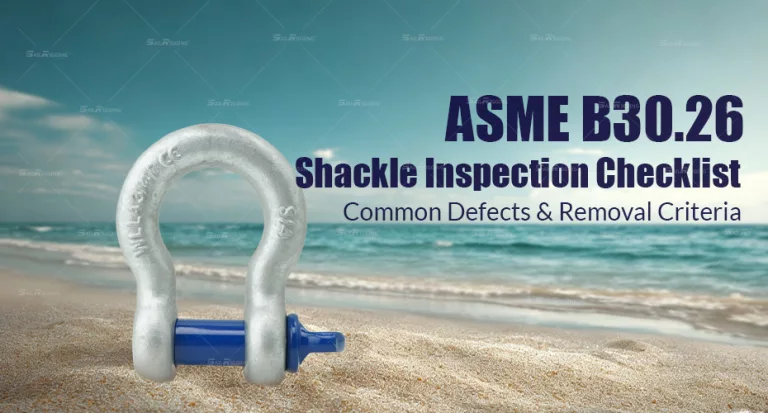
ASME B30.26 Shackle Inspection Checklist: Common Defects & Removal Criteria
In lifting and rigging systems, the lifting shackle is often a key connection point. Once a lifting shackle fails, it not only leads to equipment damage but also may cause serious safety accidents. Therefore, conducting standardized inspections and selections based on the ASME B30.26 standard (US type shackles) is of vital importance for construction units, equipment rental companies, and rigging purchasers.
Table of Contents
The Cost of Using a Defective Shackle
The cost of using a defective shackle is far more than just replacing a single product.
Firstly, there is the safety risk. If the shackle breaks or the pin falls off, it may cause heavy objects to fall, directly threatening the safety of personnel. Secondly, there is the economic loss, including equipment damage, project delay and even legal liability.
Many accident cases have shown that the problem often does not lie in the design but stems from “uninspected” or “using substandard products”. Therefore, establishing a standardized inspection process in actual operations is the first step to reducing risks.
Complete Shackle Inspection Checklist for Buyers
Whether it is the inspection before purchase or the check before on-site use, it is recommended to follow the list below:
1️⃣ Visual Inspection
Are there any cracks, rust or obvious damages?
Is the surface galvanized layer uniform?
2️⃣ Deformation Inspection (Deformation)
Whether the bow shape has been elongated or deformed
Whether both sides are symmetrical
3️⃣ Pin Condition Check
Is the pin bent or worn?
Is there any cross-threading or jamming?
4️⃣ Thread Integrity Inspection
Whether the thread is complete and undamaged
Whether it can be smoothly screwed in and tightened
5️⃣ Marking Inspection
Is the WLL (Working Load Limit) clearly marked?
Is there a manufacturer’s identification and specification?
If any of the above items is abnormal, further assessment should be made as to whether to continue using it.
Common Defects That Indicate Poor Manufacturing Quality
In actual procurement, some common defects often stem from manufacturing quality issues rather than usage wear and tear.
- Material issues
The use of low-grade carbon steel results in insufficient strength, making it prone to deformation or fracture under heavy loads.
Forging defects, such as internal porosity and inclusions, are hard to detect with the naked eye, but they can seriously affect the load-bearing capacity.
- Poor surface treatment
A too thin or uneven electroplating layer can easily lead to early corrosion. In contrast, hot-dip galvanizing is more suitable for outdoor and marine environments.
- Dimensional deviation
Poor fit between the pin and the body can easily lead to looseness or uneven force distribution.
These problems are particularly common in low-priced products, so choosing qualified suppliers is especially crucial.
- Explanation of ASME B30.26 Removal Criteria
According to ASME B30.26 standard, when the shackle shows the following conditions, it should be scrapped immediately and not be used any longer:
Obvious deformation (such as bending, increased opening)
Wear exceeding 10% of the original size
Appearance of cracks or structural damage
The pin shaft cannot be locked normally or is missing
The marking is illegible (WLL is missing)
It should be noted that many accidents occur during the “barely usable” stage – that is, when problems have emerged but replacement has not been carried out in a timely manner. Therefore, establishing clear scrapping standards is more reliable than simply relying on experience.
How to Choose a Reliable Shackle Supplier
Controlling quality from the source is the key to reducing the pressure of later inspections. When choosing suppliers, the following points can be given priority attention:
1️⃣ Materials and Techniques
Whether to use high-strength carbon steel (such as C1045) or alloy steel
Whether it is a drop forging process
2️⃣ Mechanical Performance Testing
Whether to conduct Proof Load (2 times the working load test)
Whether there is Breaking Load (4-6 times the ultimate load) data
3️⃣ Standard Compliance
Whether it complies with ASME B30.26
Whether it meets ASTM or other international standards
4️⃣ Quality Traceability Capability
Is batch management available?
Is a test report provided? Why Quality Shackles Reduce Inspection Risk
High-quality shackles not only have more stable load-bearing capacity but also significantly reduce the complexity of daily inspections.
For instance, products that have undergone strict heat treatment and testing have a lower probability of deformation; clear markings and consistent dimensions also make it easier for on-site personnel to determine compliance.
In the long run, although the procurement cost of choosing high-quality products is slightly higher, it can reduce the frequency of replacement and lower the risk of accidents, resulting in a lower overall cost.
Conclusion
In lifting and rigging operations, although shackles are small, they bear crucial safety responsibilities. By adhering to the inspection checklist and scrapping standards of ASME B30.26 and choosing reliable suppliers from the source, risks can be effectively reduced and operational efficiency enhanced.
For procurement personnel and on-site managers, what truly matters is not whether there are problems or not, but whether there is a systematic approach to identifying problems and addressing them promptly. If you have any question, don’t hesitate to contact Sail Rigging.