


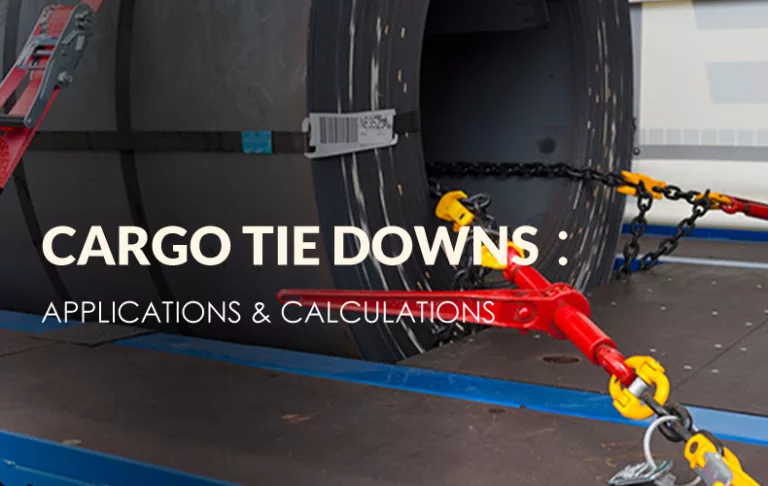
Cargo Tie Downs: Applications & Calculation
Strong and durable tie-down equipment plays vital role in commercial transportation and cargo control. It’s virtually impossible to prevent all movement during cargo transport; what we can do is use tie down to minimize or prevent cargo movement as much as possible. Well-designed and strong tie-down equipment will help operators safely and efficiently secure cargo, minimizing the risk of cargo shifting during transport. From everyday cargo transport to heavier, irregularly shaped goods, different tie-down equipment is needed to provide consistently reliable performance.
Table of Contents
Common Cargo Tie Down Equipment
Tie down chain, load binder, welded on D ring, load binder, ratchet buckles are common examples. Among these, ratchet type load binders, chain hook assemblies, and webbing are popular, meeting specific load requirements and working load limits (WLL), providing suitable solutions for each cargo securing scenario.
• Chain
• Load binder
• Web straps or synthetic
• Rope, natural or synthetic
• Wire rope or cable
• Steel strapping
Applications of Cargo Tie Down Equipment
Cargo tie down are used to secure cargo on flatbed trucks and cargo ships, suitable for industrial applications, and also used in RVs and other transportation and industrial sectors. For example, they can be used to secure cargo on flatbed trailers, heavy-duty cargo control hardware for enclosed trailers, and tie-down hooks and buckles for securing cargo on ships, aircraft, and trucks.
Certification, Safety, and Compliance of Cargo Tie Down Equipment
Each piece of cargo tie-down equipment is marked with its Working Load Limit (WLL), and must comply with industry standards and regulations, assuring operators and fleets that their cargo is properly secured, thus reducing the risk of cargo damage or penalties during transport. Regulations and standards for cargo tie-down equipment exist in the United States and Canada; the following are US regulations and standards.
• FMCSA – Federal Motor Carrier Safety Administration
• 49 CFR Parts 392 and 393
• DOT – Department of Transportation
• State Departments of Transportation
• CVSA – Commercial Vehicle Safety Alliance
• SAE J684 Trailer Couplings, Hitches, and Safety Chains
• ANSI/ASAE S338.5 – Agricultural Field Equipment – Safety Chains for Towed Equipment
• WSTDA – Web Sling and Tie Down Association
– Recommended Standard for Synthetic Webbing Tie-Downs (T-1) – Recommended Standard for Load Binders Used with Chain Tie-Downs (T-6)
• TTMA – Truck and Trailer Manufacturers Association
• NATM – National Association of Trailer Manufacturers
• NACM – National Association of Chain Manufacturers
Common Cargo Securement Basic Terminology
When transporting goods, we often encounter some basic terminology related to cargo securement. Understanding these basic terms will help you choose more appropriate cargo securement equipment and efficiently secure your cargo.
1. Cargo Securement System – Refers to the method used to secure or restrain cargo, including all components of the vehicle structure, securing devices, and systems.
2. Working Load Limit (WLL) – The “Working Load Limit” (rated load) is the maximum load that a chain or sling assembly can withstand at any time or under any conditions when the load is evenly applied to an undamaged, straight chain, strap, or fitting.
3. Proof Test – The “Proof Test” (manufacturing test force) is the minimum tensile force that the chain withstands when a continuously increasing tensile force is applied to the chain during manufacturing. These loads are manufacturing integrity tests and should not be used for use or design purposes.
4. Minimum Breaking Force – The “Minimum Breaking Force” is the minimum force at which the chain breaks when a continuously increasing tensile force is applied during manufacturing testing. Breaking force values do not guarantee that all chains will withstand these loads. This test is a manufacturer’s attribute acceptance test and should not be used for use or design purposes.
5. Total Working Load Limit – The load of the cargo securement system must be at least 50% of the weight of the secured cargo. Excerpt from the U.S. Federal Motor Carrier Safety Administration (FMCSA) Cargo Securement Driver’s Handbook.
Two Basic Types of Cargo Securement Applications
1. Indirect Securement
• Not directly connected to the cargo
• Applies force to the object, “securing” it to the vehicle
• Must remain taut to be effective
• The tension of the strap does not change when the cargo moves
• Relies on friction to be effective, therefore must remain taut
Each securement device must be equipped with a device that the driver can tighten and re-tighten, and a device to prevent loosening while the vehicle is traveling on the highway. This is called “secondary locking.”
2. Direct Securement
• One end connected to the vehicle, the other end connected to the cargo
• Can be placed between the cargo and the vehicle structure
• Can be wrapped around the cargo and then connected back to the same side of the vehicle
• Does not need to remain taut to be effective
• Overtightening will reduce its strength
• Tension increases or decreases when the cargo moves
Minimum Securement Strap Calculation Method
Direct Securement = Cargo Weight / Working Load Limit (WLL)
Indirect Securement = Direct Securement / 2
Similar to cargo length in 10-foot increments, you must always round up the number of securement devices to the nearest whole number (e.g., 4.1 rounds up to 5).
FMCSA Calculation Method
Total Working Load Limit = Total Cargo Weight / 2
The total working load limit of any securement system must be at least 50% of the weight of the cargo being secured.
Minimum Number of Binders = Total Working Load Limit / Securement Working Load Limit (round up the number of securement points to the nearest whole number)
The total number of securement points calculated by length requirements must be met: Greater than 5 feet = 2 securements. If greater than 10 feet, add one securement, and then add one more securement for every additional 10 feet.
Conclusion
Understanding securement terminology, application types, and securement device calculation methods is crucial for selecting the appropriate securement devices and ensuring the safe arrival of cargo. If you have any questions or don’t understand anything about cargo securement, feel free to contact Sail Rigging.