
Link Chain Production Process: From Raw Material to Finished Product
Link chains are important tools widely used in industries such as marine, transportation, and rigging. Today we will talk through link chain production process , from raw material to finished chains, hope this will help you to understand more about the production process of link chain, how affects strength, durability, and performance.
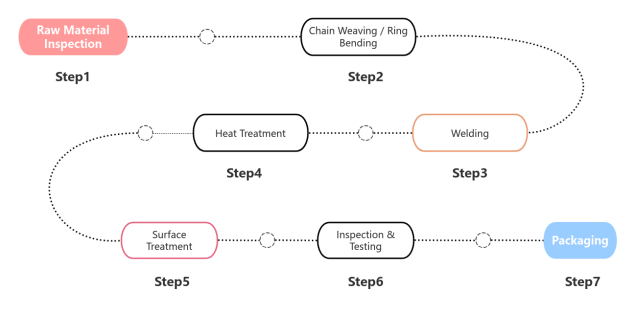
Raw Material Inspection
The production of link chains starts with raw material inspection. Different materials are chosen based on the specific requirements of the chain’s intended application and working conditions.Link chains are usually made from Q235, 20Mosi, 20Mn2.
Carbon steel Q235: Widely used in the manufacture of chains for general industrial purposes. It provides good strength for lightweight chains, such as those used in transmission systems and mechanical applications where tensile strength requirements are not high.
Alloy steel 20MoSi: Renowned for its excellent wear resistance, high tensile strength and toughness. This alloy steel chain is often used in high-temperature or severely worn working conditions and is also widely applied in heavy machinery and lifting and hoisting fields.
Alloy steel 20Mn2: As a high-strength low-alloy steel, 20Mn2 is often used to manufacture chains designed to bear heavy loads. It has excellent comprehensive mechanical properties and is suitable for high-load and high-strength application scenarios, such as heavy lifting chains and transportation chains. Before any raw materials are put into production, they must undergo strict inspection to verify their chemical composition, tensile strength and hardness. These factors are crucial for determining the final performance and service life of the chain. Once the raw materials pass the inspection, they can proceed to the next stage of the production process.
Chain forming/Chain link bending
The first step in manufacturing chains is to shape individual chain links. First, the steel raw materials are cut into steel bars of specific lengths, and then processed into the shape of chain links using a chain forming machine. This process is of vital importance because the shape of each link directly determines the strength and flexibility of the entire chain. For chains that require a specific configuration, an additional “chain link bending” process may be necessary. During this process, mechanical presses or other specialized equipment are used to bend the chain links to the precise specification requirements. This stage has extremely high requirements for precision, as any minor error may weaken the strength of the chain and thereby affect its ability to bear heavy loads.
Welding
Welded chain is more secure, load capacity is bigger. After the chain links are formed, they need to be connected to each other to form a continuous chain. The two ends of each chain link are welded together through welding technology. According to the specific requirements of the chain, we will adopt the following welding methods: Flash butt welding – this method is mainly used for welding large-diameter chains. It uses the flash generated by the electric arc to instantly heat the material to the welding temperature, thereby forming a connection point that is both strong and highly resilient, capable of withstanding extremely high stress. Resistance butt welding – For chains with smaller diameters or thinner walls, resistance butt welding technology uses the resistance heat generated when current flows through the contact points of the chain links for welding. This is an efficient thin-walled chain connection process. Gas shielded welding – This process uses shielding gases (such as argon) to shield the welding area to prevent oxidation. This technology is often used in high strength chains to ensure that the weld seams firm and clean.
Heat Treatment
Enhance Strength and Durability After welding is completed, the chain needs to undergo a heat treatment process to enhance its strength and wear resistance. The specific approach is to heat the steel chain links to a specific temperature and then perform rapid cooling (i.e., quenching). Immediately following, tempering treatment is carried out, aiming to eliminate internal stress and enhance toughness. For chains specifically designed for special working conditions – such as those that need to withstand severe wear or high stress – additional heat treatment methods may be required, which specifically include: induction hardening: The surface of the chain is heated by medium-frequency current and then rapidly cooled. This process can form a hardened layer on the surface of the chain, thereby enhancing its wear resistance and impact strength. This technology is often used for chains in heavy-load environments. Salt bath quenching: Immerse the chain in a heated salt bath and then rapidly cool it. This process can enhance the surface hardness while maintaining the integrity of the internal material structure. Salt bath quenching is often used to enhance the corrosion resistance and hardness of chains, especially suitable for chains in damp or high-temperature environments. Carburizing treatment: This method involves penetrating carbon into the surface of the chain at high temperatures to form a hard outer layer. Carburizing treatment can significantly enhance the wear resistance of chains, and thus is highly suitable for high-strength chains operating in abrasive environments. The above-mentioned heat treatment technology can comprehensively enhance the surface hardness, strength and overall durability of the chain, thereby ensuring that it can still maintain reliable performance under harsh working conditions.
Surface treatment
After the anti-corrosion protection heat treatment process is completed, the surface of the chain still needs to be treated. This process is of vital importance, aiming to protect the chain from corrosion and thereby extend its service life. Common surface treatment processes include: galvanizing: Applying a protective zinc coating on the surface of the chain to prevent rusting; This makes this type of chain an ideal choice for outdoor or Marine environments (i.e., environments with a higher risk of corrosion). Coating and painting: Chains can also obtain additional anti-wear and anti-corrosion protective layers through coating or painting processes, while also enhancing their aesthetic appearance. These surface treatment processes not only enhance the chain’s corrosion resistance but also ensure its long-lasting durability in harsh environments.
Packaging
After the transportation preparation has undergone testing and inspection, the final process is packaging. The packaging form is usually specified by the customer. Common packaging containers include gunny bags, plastic drums, steel drums, plastic boxes, cartons, wooden boxes and plastic pallets. These packaging solutions are designed to ensure that the chains are properly protected during transportation and handling. According to the specific requirements of the customer, the chains will be coiled, bundled or packed in boxes by weight or length. To further enhance protection during transportation, chains are usually wrapped with plastic film or other protective materials. In addition, each package is affixed with a label indicating the product specifications, load-bearing capacity and production batch number for easy identification.
Final Inspection and Testing
The final stage of the production process is final inspection and testing. At this stage, the products will undergo a comprehensive inspection to ensure that they meet all established standards before shipment. Throughout the entire production process, we will conduct tests on randomly selected samples. The inspection items include appearance, size, load-bearing capacity and breaking load. The final inspection covers the following aspects: Visual inspection: Check whether there are any visible defects on the surface of the chain, such as cracks or scratches. Dimensional measurement: Measure the size and shape of each link to ensure they comply with the design specifications. Identification verification: All chains must be accompanied by clear identification for traceability. The identification content includes the production batch number and material code. Weight verification: Check the weight of each chain to ensure it is within the specified allowable range. Surface hardness test: Test the hardness of the chain surface to ensure it meets the required standards. Load test: Conduct load tests on the sampled chains to simulate the usage environment under actual working conditions. Fracture load test: Randomly selected samples are subjected to fracture load tests to ensure they can withstand extreme stress. Only after passing all the above tests can the chain be approved for shipment.
Conclusion
How to produce link chains are important for the strength, durability, and safety necessary for industrial applications. From raw material inspection to finished chains, every link is crucial for creating reliable products. A thorough understanding of the production process helps to select the most suitable chain products in harsh working environments, thereby ensuring that the chain can still maintain reliable performance when subjected to heavy loads and high stress. For manufacturers, strictly adhering to these rigorous production processes and quality control standards is of vital significance for maintaining a high level of product quality and ensuring reliable performance of their products across all industries. If you have more question about link chain, please feel free to contact Sail Rigging.